Thursday, 21 July 2011

Propinquity Marketing, QR Codes and the Mobile Future.


The law of propinquity states that the greater physical (or psychological) proximity between people, the greater the chance that they will form friendships or romantic relationships.
Other things being equal, the more we see people and interact with them, the more probable we are to like them.
Mobile Marketing & QR Codes is the ultimate propinquity marketing tool because as Tom Martin put it "quite often, that mobile phone is the last item in the same hand that is about to grab the wallet that is going to be used to purchase your product or your competitor's". With Google & Barclays now delivering mobile payments that hand no longer reaches for the wallet so Mobile Marketing should be high on the to do list..


Follow Blue Crayon 

Wednesday, 13 July 2011

How different age groups interact across the social media

Good infographic here from online community moderation firm Community 102 that looks at how different age groups interact online across the social web. 

Most active social media age range is 35-44 year olds (25%) 
in comparison to 9% of 18-24 year olds.

Biggest group of Facebook users are between 18-25 (29%). 
Twitter was older biggest group there: are 26-34 yr olds  (30%).
Average LinkedIn user is 44 years old and 
Average Twitter user is 39 years old.


Follow Blue Crayon 


by @gordonmacmillan, posted on 12 July, 2011 at 11:39 am

Does gender play a role in the way consumers view online ads?

We all know the old saying, “Men are from Mars and Women are from Venus”, but are the two sexes really that far apart when it comes to what online advertisements they both view?

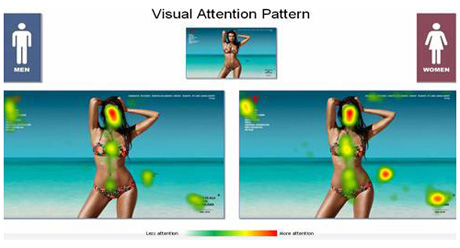
Surprisingly, with only a few differentials, both sexes look at various online ads in the same manner, according to EyeTrackShop, creators of the world’s first eye tracking technology.
In a recent study conducted in Norway, EyeTrackShop enlisted 100 participants, over 2 days, using test ads from the H&M website, Reebok and Saab in hopes of finally answering, does gender play a significant role in the way consumers look at ads, packages and other stimuli.
Below, find EyeTrackShop’s visual attention patterns and visual fixation order for the H&M website test. You can draw your own conclusions.


Follow Blue Crayon 


Article by Ivan | Tue, 2011-07-12 17:12

Wednesday, 6 July 2011

Why Do Customers Tattoo Themselves with the Brands They Love?

I saw this tattoo walk past me whilst I lay by the pool on holiday last month and i thought to myself 1- I must get a picture! and 2- How amazing it was that a brand has managed to build itself such incredible customer loyalty  and become so loved that someone would tattoo its logo in appreciation and support. However, it is more common than you might think.. 

Hugo Boss, Harley-Davidson, Nike, Playboy, Coca-Cola, VW, and Apple logos have been permanently etched into the skins of customers worldwide. Why do they do it? Why do these  fans, or Brand Lovers, scorch their bodies with a company’s mark? And what can marketers and brand managers learn from them?

Most acts of unabashed brand loyalty are a genuine mystery to marketers: Why do customers anxiously camp outside IKEA grand openings? Why do bikers brand Harley’s flaming eagle onto their arms?
From our research into the nature of Cult Brands and Brand Lovers, we understand that a brand's outliers—their most outrageous fans and radical customers—are the people with whom marketers should engage, talk, and most importantly, listen.
Although tattooing brand logos and imagery may seem too extreme to marketers, these outliers represent a brand’s choir. These radical customers understand your business on a deeper, more meaningful level than marketers.
Tattoos, when understood, can teach marketers about consumer motivation. Tattoos were once considered counter-cultural in America. People branded themselves with tattoos to mark themselves as different and to challenge the societal status quo. Today, body art is a part of mainstream American culture.
Why Do People Get Tattoos of Brands?
Think about what the term “branding” really means and you'll have a better appreciation for the importance of the psychology of tattoos. We have a biological instinct to mark ourselves. While body art may scar the body, its meaning is brandedinto our souls.
There are many psychological reasons customers brand themselves with tattoos of the companies they love:
  1. Membership into Social Groups: Brand tattoos help customers bond with others in the same social group who share special interests and common values. Brand tattoos send a message that they belong to a unique, personally meaningful community. You only “get the message” if you're part of that group.
  2. Finding Meaningful Associations: Brand tattoos remind customers of personal values. The tattoo is a permanent badge with special meaning. It creates a powerful recall cue of the memories, experiences, emotions, and other positive associations they have with the brand. A single image, as represented by the tattoo, can encapsulate a series of complex memories and feelings.
  3. Connecting with Ideals: Brand tattoos are reminders of the customer's ideal life. The brand becomes associated with specific ideals, as Apple has become inextricably linked to creativity, beauty, and expression. Customers see the brand's mark as a reminder of these ideals, and they draw strength from the image.
Customers instinctively look for meaning; they naturally look for something to rally around; they crave an emotional payout from their interaction with the brands they love. Brand tattoos create a permanent physical connection between the customer and the brand. In a world where most businesses focus exclusively on growth and sales, the opportunity for businesses to serve customers on a deeper level remains open and waiting. The results can be magical, and yes, growth and sales often follow suit.
What Four Qualities Do Tattooed Brands Share?
The most popular brands that people tattoo on themselves like Harley-Davidson, Nike, Playboy, Coke, and Disney share certain qualities:
  1. Tattooed brands are iconic in nature; they are deeply rooted in our contemporary cultural mythology.
  2. Tattooed brands have strong visual appeal—an iconic image like the Nike symbol is a powerful visual marker.
  3. Tattooed brands are effective at lifestyle marketing. They represent and promote a way of being in the world, a lifestyle philosophy. Vans and Jimmy Buffet are terrific examples of successful lifestyle marketing.
  4. Tattooed brands tend to offer a promise of an ideal experience the customer is seeking. For example, Harley's blazing eagle image symbolizes freedom on the open road.
What Can Smart Marketers Learn From Customer Tattooing?
Where’s the most prevalent place for customers to tattoo the brands they love? It's not their arms, shoulders, or even backs—it's in their minds. Customers instinctively create mental tattoos, powerful associations between brands and experiences. The smarter the marketer, the more he or she will focus on creating experiences the customers want. These experiences leave a mental imprint that’s difficult to measure, but undoubtedly present. We can say that a salient mental imprint—a tattoo on the customer’s psyche—is the goal of successful branding efforts.
Smart marketers will learn to see tattoos as portals from the customer’s personal values to their real life experiences instead of a gateway from brand to customer. The purpose and role of the brand is to open their customers up to ameaningful experience that later becomes associated with the brand.
Again, tattoos represent an intricate web of experiences, feelings, and memories. As marketers, your job is to set the conditions for these experiences, feelings, and memories—not simply sell a product or service. (If you’d like to see an awe-inspiring illustration of this, watch our video of an IKEA Grand Opening.)
How do you set the conditions to create meaningful experiences for your customers?
  1. Start by understanding your customers. Ask your customers questions directly. If you operate a retail store with cooking supplies you might ask:
    • What is your ideal customer experience when you enter our store?
    • What do you value most when you’re cooking in your kitchen?
    • How do our products make your life easier?
    • What are the dominant feelings you get when you shop in our store?
    Questions like these can provide you with infinitely more useful information about your customers than demographics, psychographics, or focus groups.
  2. Brainstorm ways to create the ideal customer experience on a consistent basis.
  3. Develop a Brand Model around your best customers. An effective Brand Model:
    • Highlights what’s most important to your customers.
    • Aligns your organization to better serve your customers.
    • Helps you make better decisions that will impact long-term loyalty and growth.
    • Predicts consumer behavior by understanding your customer’s motivations.
The measure of success is not in the number of customers who rush out to tattoo your logo on their bodies. The most important mark will always lie in your customers’ minds. Create consistent meaningful experiences for your customers will help you “tattoo” your brand’s image in your customer’s hearts and minds.

And Finally .. Would You?..
Do you have a Brand Tattoo? If so please share it below or on our Blue Crayon facebook fan page we would love to see it.


Follow Blue Crayon 


by BJ Bueno About this author

Like Us for a chance to Win Art & Copy: Inside Advertising's Creative Revolution DVD

Like Us on Facebook for a chance to win a copy of 
Art & Copy: Inside Advertising's Creative Revolution DVD


Description


  • Features advertisers George Lois, Mary Wells, Dan Wieden, Lee Clow, Hal Riney and others who were responsible for "Just Do It," "I Love NY," "Where's the Beef--," "Got Milk," "Think Different," and brilliant campaigns for everything from cars to presidents. 

    Includes classic advertising campaigns such as Volkswagen, Samsonite, Esquire Magazine, LBJ's "Daisy" ad, MTV, Tommy Hilfiger, Nike, Fed Ex, Budweiser, Apple, Pres. Regan's "It's Morning in America" ad, and others. 

    Directed by Doug Pray (Surfwise, Scratch, Hype!). 

    Art & Copy Bonus Feature: 
    MORE COPY... LESS ART. Additional Footage (16 min/ 55 sec); also 

    Chapters: 
    Reintroducing; 
    Clientele; 
    Rings of Saturn; 
    Good Advertising; and 
    Future. 

  • This program contains language that may not be appropriate for all viewers. Viewer discretion is advised. 

    Official selection of the 2009 Sundance Film Festival and Hot Docs Toronto 2009. 

    Winner Best Director Documentary Atlanta Film Festival. 


[DVD] [Region 1] [US Import] [NTSC] Region 1 encoding (requires a North American or multi-region DVD player and NTSC compatible TV.)


Follow Blue Crayon 


Sunday, 26 June 2011

Developing a Brand for Your Small Business

Branding is about being remembered. It's not easy to get your own brand recognized by the public. Big companies spend a lot of time and money to get recognized across the country. People know the logo on their soda can immediately, but those companies have been putting out ads for many decades. You can create a brand for your small business, too. Since you probably don't have a big budget, here are some tips for branding your small business effectively and efficiently. 
You need a motto, a mission and a creative saying. This needs to be an easy and quick phrase that identifies you with the public. "ABC Sports shoes, on the right foot," or "XYZ Herbal Drink, drink to your health!"
Advertise Smart
It's important to stretch your advertising as far as possible, and this means choosing the right media. You need to find your target audience and focus there. If you run a chain of kid's toy stores, then don't spend £500 on one big ad in the local newspaper. Instead, spend £50 each on an ads in 10 local school newspapers, and buy ad spots in the school sports/event fliers. Target your ads. 
Get Seen, not Clicked
Try to get banners placed on as many sites as possible within your target audience sphere. Most businesses use the click-through method, where they only pay sites for the clicks they receive. This doesn't guarantee many sites will place you on their pages. Instead, buy some real estate outright on their sites. Offer to pay a flat amount for a prominent ad to run all month on as many relevant sites as possible. Get out there and be everywhere that relates to your industry. Focus your social media
Have a slick and simple logo designed for your business. Make it easy to recognize, and use it on everything. Have it printed on your bags, business cards and all your ads and posters. Branding comes with repeated views. The consumer needs to see your logo over and over again. - so you think you can design a logo

Free Exposure
Sponsor local events to get some attention. Often the local media will cover these events, so you get free advertising. If it's a charity event, you also get some extra goodwill in the community.
Newsletters and Press Releases 
Create a newsletter via email and snail mail, and try to build a large subscription base. Issue press releases with new company information as often as possible. - How To Write A Press Release
Brand an assortment of inexpensive items, from pens and pencils to magnets and key chains - all with your logo. Give these out like candy to your customers. Spread the word with little gadgets bearing your logo and website address. Have T-shirts printed with your logo and tagline. Spending £1000 on these items will go a lot further than the same amount spent in print advertising. These small gifts will remind customers of you each time they get used.
Branding is about remembering. Don't let consumers forget you're out there. Bombard them with ads, freebies, events and press releases on a regular basis. Regular and consistent exposure wins the race. 


Follow Blue Crayon 


Article by Rod Little, Yahoo! Contributor Network

Tuesday, 21 June 2011

Consumers Now Spending More Time on Mobile Apps Than the Web

Consumers are spending more time on mobile apps than on the web for the first time, a new report claims.


Flurry compared its mobile data to stats from comScore and Alexa, and found that in June, consumers spent 81 minutes per day using mobile apps, compared to 74 minutes of web surfing. (See chart below.) The shift comes as combined tablet and smartphone shipments eclipsed those of desktops and notebooks for the first time, according to a recent report by Mary Meeker, partner at Kleiner Perkins Caufield & Byers.
Flurry found consumers spend 9% more time, on average, using mobile apps. The report found that the growth in mobile app usage came mostly from more sessions per user, rather than longer sessions overall.
Those sessions, by and large, are consumed by the use of games and social media apps, which took 47% and 32% of the total amount of time used for such apps.
If the stats bear out, the data is vindication for Wired, which last year declared “The Web is Dead,” and predicted that apps would soon overtake it.